
Searching Gratiot County Civil Dockets
Start with MiCOURT Case Search. It is the statewide index of public Gratiot County civil docket entries. Searching by name? You will need a last name or a business name. Searching by case number? The panel takes Year, Number, and Type. Where the tool lets you pick a location, choose the Gratiot court. Use the Civil category when offered. Matching works best with a case number. Combine it with the right court and a filing year rather than a party name alone.
MiCOURT is an index, not a full document archive. A result row shows plenty: the party role, filing date, case status, judge, next event, public status, and any listed disposition. That detail helps separate a live case from a similar name. It also separates one from a closed matter with collection activity. The official court file stays with the clerk or court that holds it. Document access can be narrower than what the index row reveals.
- Open MiCOURT and choose a name or case-number search for the Gratiot court.
- Enter the required last name or business name, or enter the case year, number, and type from a court notice.
- Use the Civil category and confirm the court before opening a result.
- Compare the parties, filing date, status, event history, and public status with the matter being located.
- Ask the court or clerk for a public document, a certified copy, or a record search if the index is insufficient.
Note: Search fields narrow an index result. They do not confirm what a court order says or whether it still applies.
MiFILE at Gratiot Civil Court
MiFILE also goes by the name TrueFiling. It exists for filing papers with the Gratiot civil court. It is not for public docket searching. Under a local administrative order, the 65B Civil Division requires all civil litigation filings to go through it. Filers pick the right court and use approved forms. Once the court accepts a filing, the public index stays the way to locate a Gratiot civil docket.
The Civil Division’s official page spells out the filing mandate. It also notes a lobby workstation for the e-filing process.
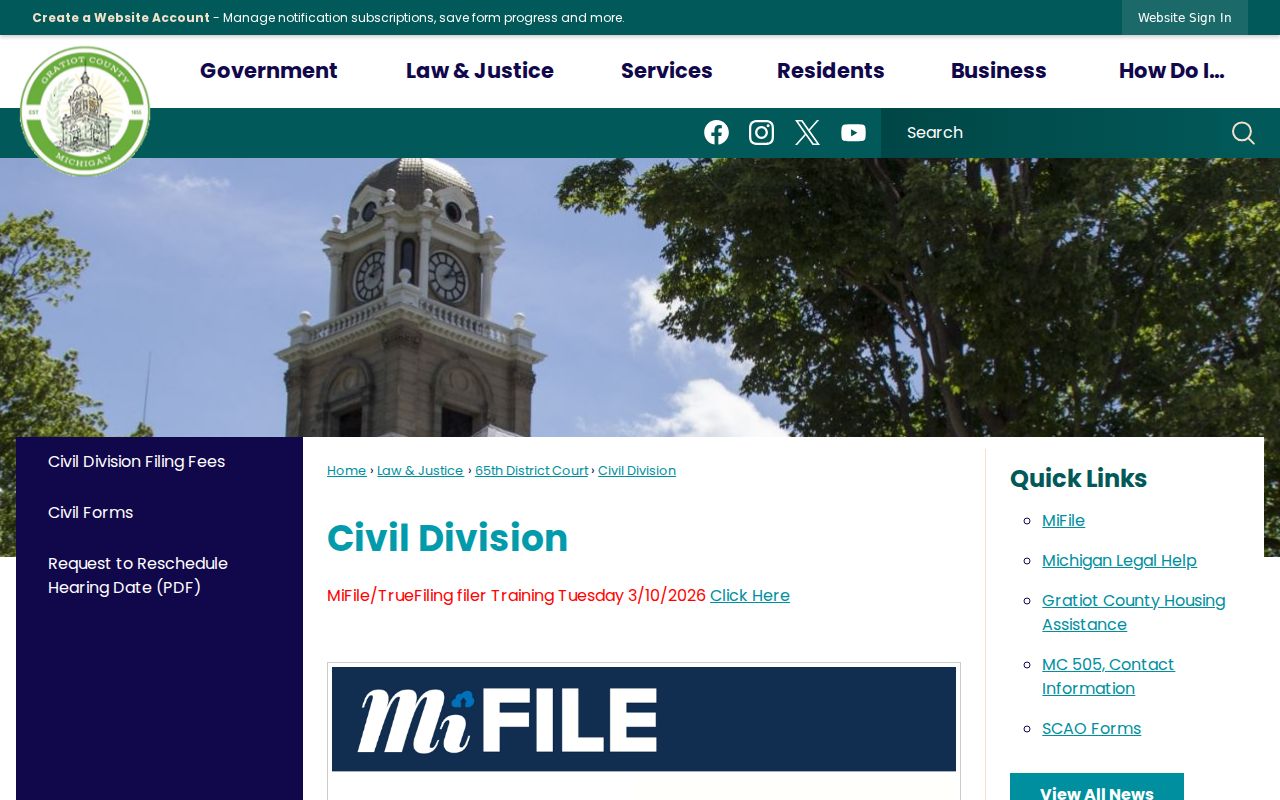
That lobby workstation comes with a computer, scanner, and printer. Deputy clerks can help with the mechanics, though not with legal advice. To sign in, the MiFILE login asks for an email address and password. Controls cover the account, available courts, and password help. The available-courts materials list MI Gratiot County, Ithaca, 65B District Court. The system may show separate court, e-filing, and payment-processing charges. A transaction total is not one universal filing fee.
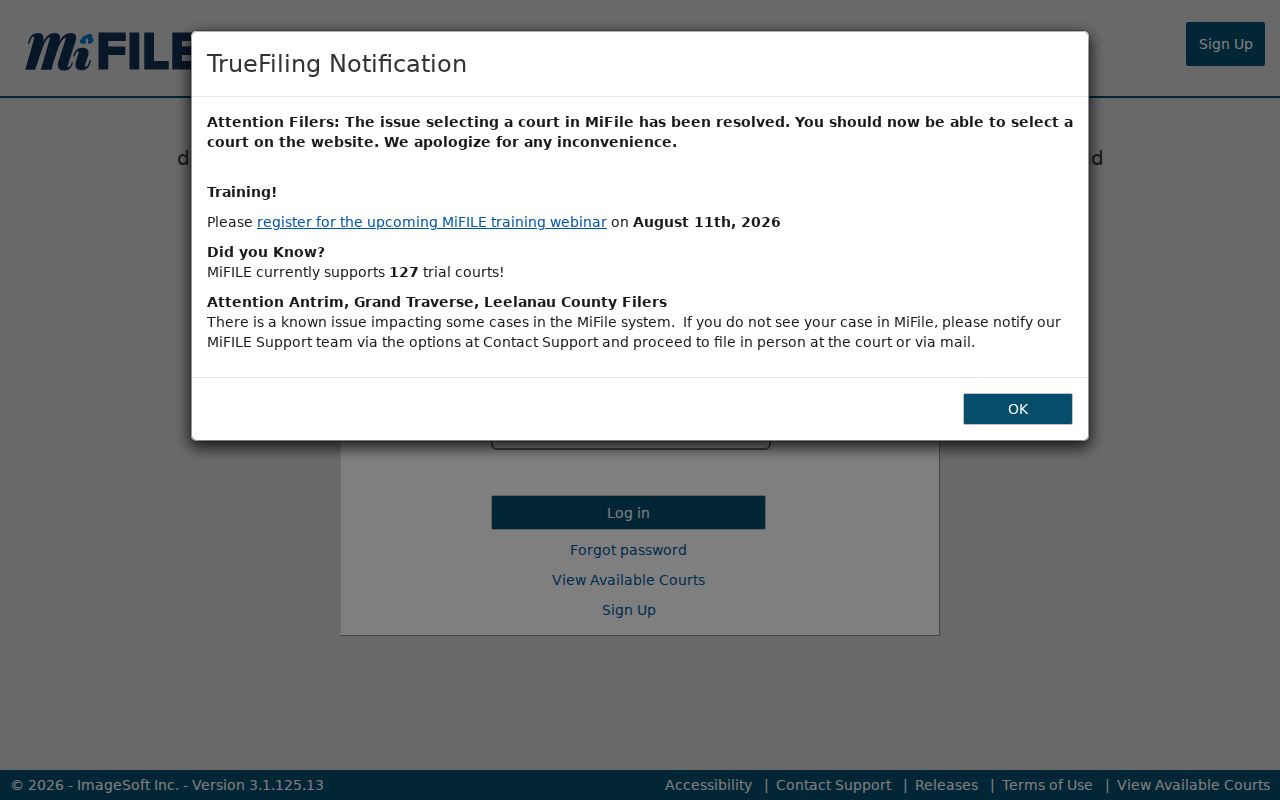
An account serves filing work. For a public civil docket or the official record, MiCOURT and the clerk remain the routes that matter.
Inside a Gratiot County Civil Docket
A civil docket is a dated register of what has happened in a case. Public entries can carry plenty of detail. Expect the case number, parties, filing date, status, assigned judge, event, and disposition. One filing might be an initial claim. Another could be a response, motion, notice, order, or judgment-related entry. The index often names an event without showing the whole pleading or exhibit. So request the official public file when the text of a document matters.
Read the docket as a sequence. A motion is a request for court action, not a ruling. A hearing setting is only a scheduled event. It is not proof the hearing occurred or that the judge decided anything. A disposition or judgment entry records a result, yet later activity can still follow. Gratiot County civil docket entries make the most sense with a check. Match them against the case number and court.
| Case number | Michigan search fields use a year, number, and type; retain all three with the court name. |
|---|---|
| Parties and roles | The displayed parties and their court roles help distinguish similar names. |
| Filing date and status | When the case began and whether the system shows it as open, closed, disposed, or another status. |
| Event and judge | A recorded or scheduled action and the judicial assignment, where public. |
| Disposition | The recorded outcome; the official file supplies the authoritative document text. |
Gratiot Civil Index Limits
A MiCOURT result proves a public civil case exists and gives event-level detail. It is not a free substitute for every pleading, exhibit, order, or certified copy. Some records are sealed, confidential, redacted, or nonpublic under court rules. Some public documents carry a request and copying charge. A court record may even arrive in a form other than an ordinary printed page.
The Gratiot County route: identify the court and case number first. Then request the public file material from 65B or the County Clerk. A 65B request form covers review and copies. It also covers the complete public file, a specific document, and recordings. The clerk can tell you which parts are available and the charge before releasing them.
Civil Case Types on the Docket
Jurisdiction decides where a Gratiot civil case begins. Small claims through $7,000 belong to 65B District Court. So do general civil matters through $25,000. Civil matters generally over $25,000 go to the 29th Circuit Court. Routing matters for a docket search. The case may be indexed through the district court or held by the circuit court and County Clerk.
| Gratiot civil route | What the docket can cover | Where to ask |
|---|---|---|
| 65B small claims | Claims within the local $7,000 small-claims limit. | 65B District Court, MiCOURT, or its public-record process. |
| 65B general civil | General civil cases within the local $25,000 limit. | 65B District Court, MiCOURT, or its public-record process. |
| 29th Circuit civil | Civil matters generally over $25,000 and circuit-level civil files. | 29th Circuit Court and County Clerk records counter. |
For the local split of civil jurisdiction, see the 65B District Court page and the 29th Circuit Court page. A case type label helps, but read it with the court. It is no substitute for the filed claim or judgment.
Gratiot Civil Filing Fees
The 65B Civil Division fee page splits filing fees into tiers by route and amount. Small claims run $30 up to $600. The fee is $50 over $600 through $1,750. It climbs to $70 over $1,750 through $7,000. General civil costs more. The fee is $35 up to $600, $55 over $600 through $1,750, and $75 over $1,750 through $10,000. A claim over $10,000 through $25,000 pays $160.
Other line items matter too. A civil jury demand adds $50, and a civil motion adds $20. Copies of ordinary pleadings run $1 per page. Certified copies cost $10 plus $1 per page. Fees can shift, and e-filing may carry separate system charges. Check the current schedule before you file or order a paid copy.
The official fee table lays out the tiered structure the Civil Division uses.
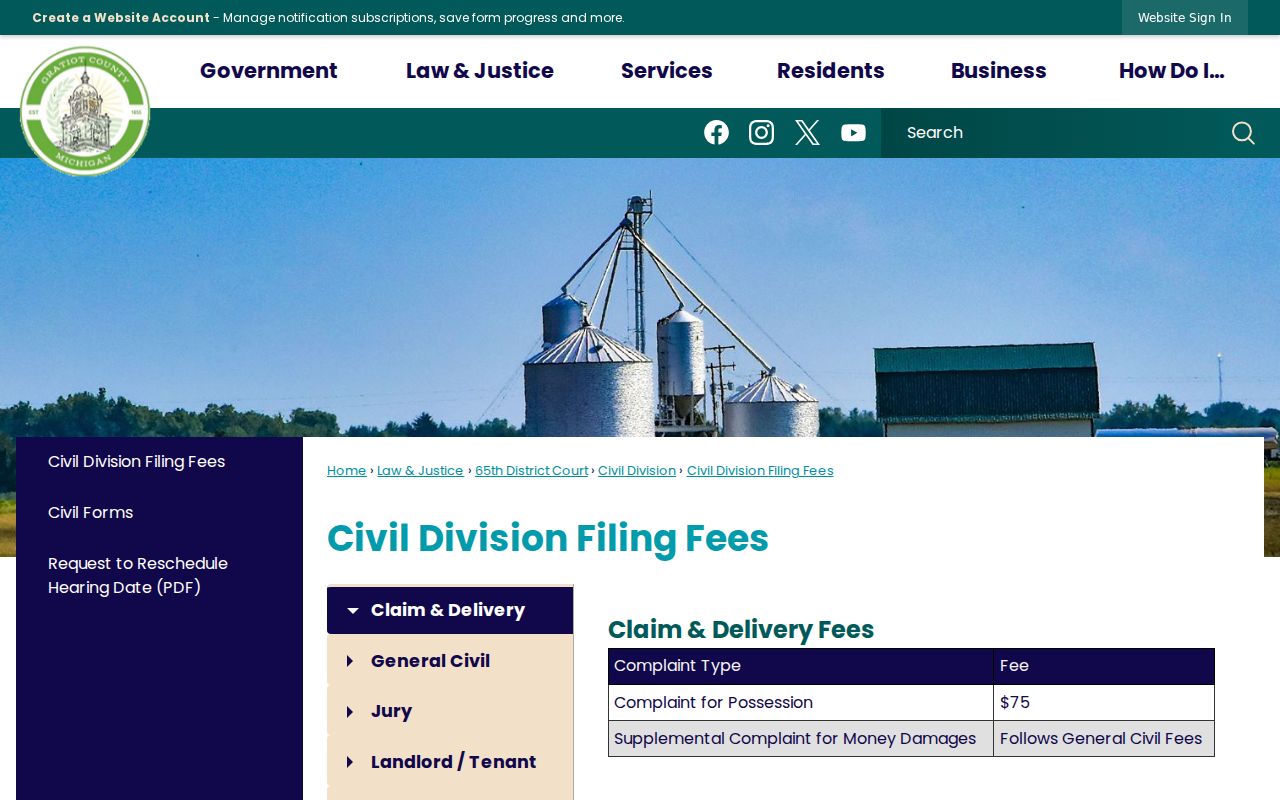
Gratiot County filers get on the right civil route by pairing the case category with the dollar amount. Do that before the clerk opens a docket.
Civil Docket Settings and Hearings
A docket setting is a calendar event for a civil case. It might be a motion, conference, hearing, or trial. MiCOURT posts public event details. The 65B Court Display goes further, listing the public Party Name, Time, Room, and Case Number for the date you pick. Still, confirm any setting with the court. The calendar refreshes often, and schedules can shift.
Circuit civil cases follow a different route. The county’s Scheduling Information page sends parties to the assignment clerk for date and time and lays out a motion-day rotation. One caution matters here. A notice of hearing gives the court-set time for a matter; it cannot turn an unfiled request into a docket event. For the proper record counter, call 65B at 989-875-5240, the circuit court at 989-875-5224, or the County Clerk at 989-875-5215.
Gratiot Civil Forms and PII
65B requires SCAO-approved civil forms for Gratiot County filings. Pick the category matching your type of proceeding. Then use MiFILE for the litigation filing route. Staff can help with the lobby equipment. They cannot advise which claim, form, or legal position to take.
Recreated forms carry a real risk of rejection, forcing resubmission at the filer’s expense. Michigan’s protected-personal-information process applies to public filings too. A court docket can name the case and its public events without opening protected details. Don’t add protected identifiers just because a docket exists. The filing rule and the access rules work together, so a searchable index never erases redaction, sealing, or confidentiality requirements.
The Civil Forms page lists the approved-form categories.
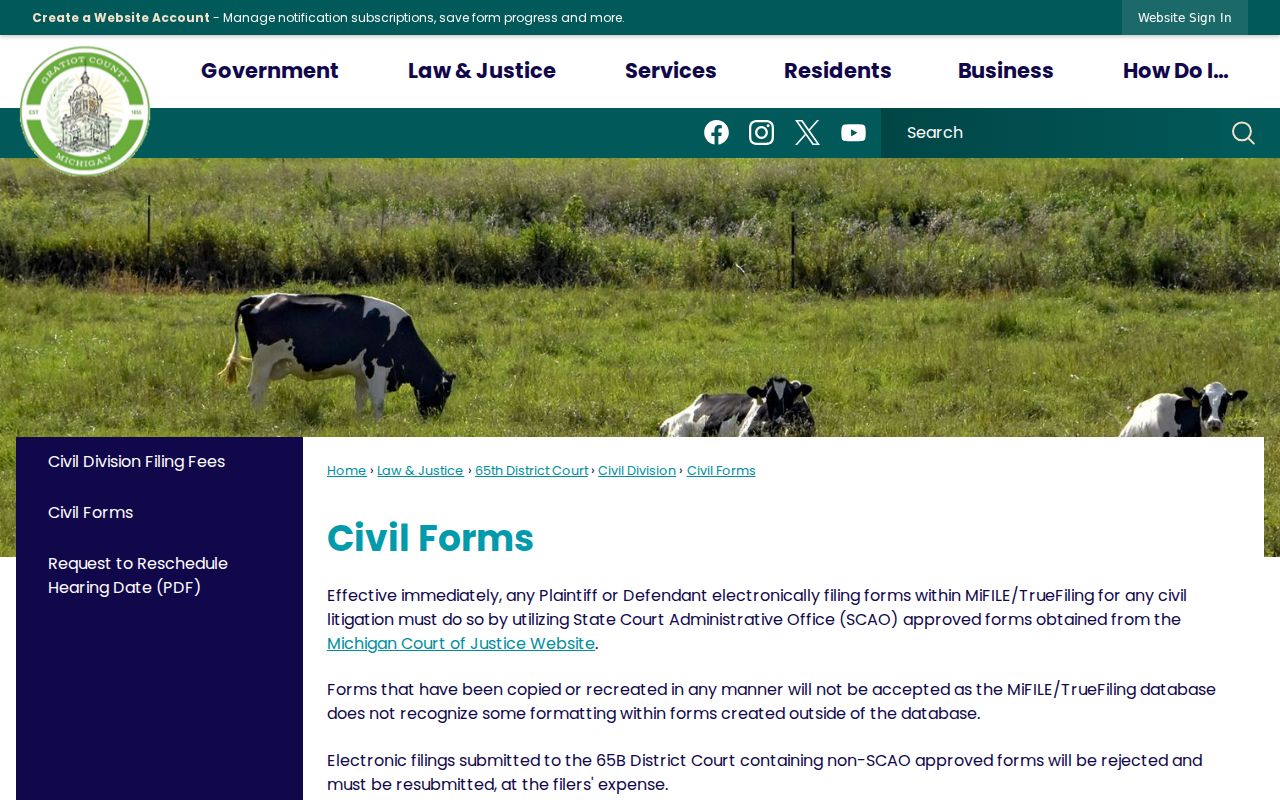
Approved forms plus careful handling of protected details keep a Gratiot filing out of the correction queue. That keeps it moving toward the civil docket.
Civil Docket Access Rules
In Michigan, court rules govern access to judicial case records, not a FOIA request for an ordinary file. The lead rule is MCR 8.119, with related Michigan Court Rules alongside it. Public civil records can be inspected and copied. But sealed, confidential, redacted, and nonpublic material stays restricted. MCR 1.109 also governs filing and protected personal-identifying information. A public case title or event never makes the whole file public.
Public-file boundary:
MCR 8.119 addresses the clerk’s case record, public inspection, copying, and limits on nonpublic material.
MCR 1.109 provides Michigan filing and protected-personal-information rules.
65B Administrative Order 2013-05 supplies the local process for access requests and nonpublic records.
Gratiot Civil Record Requests
When a Gratiot civil docket entry points to a document you need, the court is your stop. Bring the case number too. An index alone will not do. The 65B terminal is open from 8:30 a.m. to 4 p.m. It runs on a first-come basis. Users sign in and out. You generally get 30 minutes unless no one is waiting. Printing costs $1 per page. Staff point to 1:30 to 3:30 p.m. for same-day request opportunities. Even then, the court may need time to locate a file or identify restricted portions.
The 65B file and copy request form covers review, copies, a complete public file, a particular document, and recordings. Submission routes include the counter, mail, phone, fax, and the court’s published email or contact channel. Pre-1996 records may need manual index-book work at the counter. Circuit civil records go through the County Clerk. A ten-year search there costs $12 per name. A different time range can bring added charges.
Copy, certified-copy, CD, email, and record-search products may each carry different charges. A case index and a clerk-certified document are different products with different access steps. So name the Gratiot court, case number, party, date range, and exact document or review type when you order.