
Searching Gratiot County Criminal Dockets
MiCOURT Case Search is the public entry point. Its name panel asks for a last name or business name; the case-number panel wants Year, Number, and Type. Pick the Gratiot court when that choice appears. Use the Criminal category where offered. An exact case number beats everything. A name alone takes more care, since people share names.
Go past the caption, though. A solid Gratiot County criminal docket match lines up on court, case type, filing date, party role, and status. MiCOURT is only an informational index. It points to a case but never replaces the official file at 65B District Court, or the County Clerk for circuit matters. A public result may also leave out documents and events.
- Open MiCOURT Case Search and choose a name search or a case-number search.
- For a name, enter the required last name or business name and narrow to the Gratiot court when possible.
- For a case number, enter the year, number, and type exactly as shown on a notice or earlier docket entry.
- Confirm the court, party role, filing date, public status, and event history before treating the result as the right case.
- Use the court counter or a record request for a public document, a limited result, or a historical search.
Note: An empty result can mean a misspelled name, a restricted record, or how a court is configured. It does not prove the case is absent.
Gratiot Criminal Searches in MiCOURT
MiCOURT keeps criminal searching apart from the live calendar. A search can return a public case index with status, judge, events, and disposition information. The official MiCOURT field examples show why the case number matters so much: it binds the year, number, and case type together. You are not relying on a shared name. Once a Gratiot criminal matter turns up, pause. Keep the court name with the case number for any clerk follow-up.
The portal warns that certain criminal convictions show only a case number or limited details. That is its seven-year display rule at work. Older Gratiot County criminal docket material may take a call to the court or clerk. Nonpublic and restricted categories are simply omitted. MiCOURT is not a bulk-download service. The public interface works only through its ordinary search controls.
Inside a Gratiot County Criminal Docket
A docket is a timeline of actions in one case. Read a Gratiot County criminal docket with that in mind. The charge, the hearing event, and the result answer different questions. A charge is an allegation placed before the court. A disposition is the recorded result for a charge or case. Think dismissal, plea result, or verdict. A sentence is the punishment or order that follows a result requiring sentencing. Mixing them up changes the story.
Case identifiers break into parts rather than naming a person. Michigan's official developer material describes a docket identifier built from case year, number, and case type. District examples can add a defendant number. The format 2020-20-0660-SM-01 is an official illustration, not a Gratiot case number. So weigh the court, case type, party role, filing date, and disposition carefully. Check them against the underlying record.
| Case number | The court-assigned identifier, often searchable by year, number, and type. |
|---|---|
| Charge | An alleged offense or count, not a conclusion about the case. |
| Event or setting | A scheduled or completed court action, such as arraignment, pretrial, or sentencing. |
| Disposition | The recorded result of a charge or case; read it with the date and status. |
| Sentence or order | A later court action that may follow a disposition and may carry its own entry. |
Gratiot Criminal Calendar Entries
The 65B Court Calendar points to the MiCOURT public Court Display. That tool is separate from the case-search index. That display lists Party Name, Time, Room, and Case Number. You pick the court and date. It refreshes roughly every 30 minutes. Names sort alphabetically by last name. The county notes that a Room value of Hearing means an informal hearing before the magistrate.
A calendar row proves one thing: a public event was scheduled. It is not the full docket, and it is not the outcome. Nonpublic cases never appear, and a blank day does not mean the courthouse sat idle. Times shift. Confirm any setting on a pending Gratiot criminal case with 65B at 989-875-5240. The 29th Circuit Court can be reached at 989-875-5224 for circuit activity.
How a Criminal Case Moves
Many Gratiot County felonies pass through two court stages. The district stage may carry arraignment and preliminary-examination entries. If the matter is bound over, the felony continues on the 29th Circuit Court docket. Misdemeanors stay in 65B District Court. Because of that split, the early events and the later felony case can sit in different court records even though they involve the same matter.
Docket flow: Filing › Arraignment › Pretrial › Plea or Trial › Disposition › Sentencing
Every stage can add its own entry. It might be a date, an order, or a status. A continuance moves a scheduled event. It decides nothing by itself. Read a closed status or disposition beside any judgment and sentence information available. For an official circuit file search, call the County Clerk at 989-875-5215.
Gratiot Criminal Docket Transfer
65B District Court handles misdemeanors plus the felony arraignment and preliminary-examination phase. 29th Circuit Court, shared by Clinton and Gratiot Counties, takes felony matters after bindover. If a criminal search stops at an early district entry, ask whether the case moved to circuit court, and hand the clerk the case number.
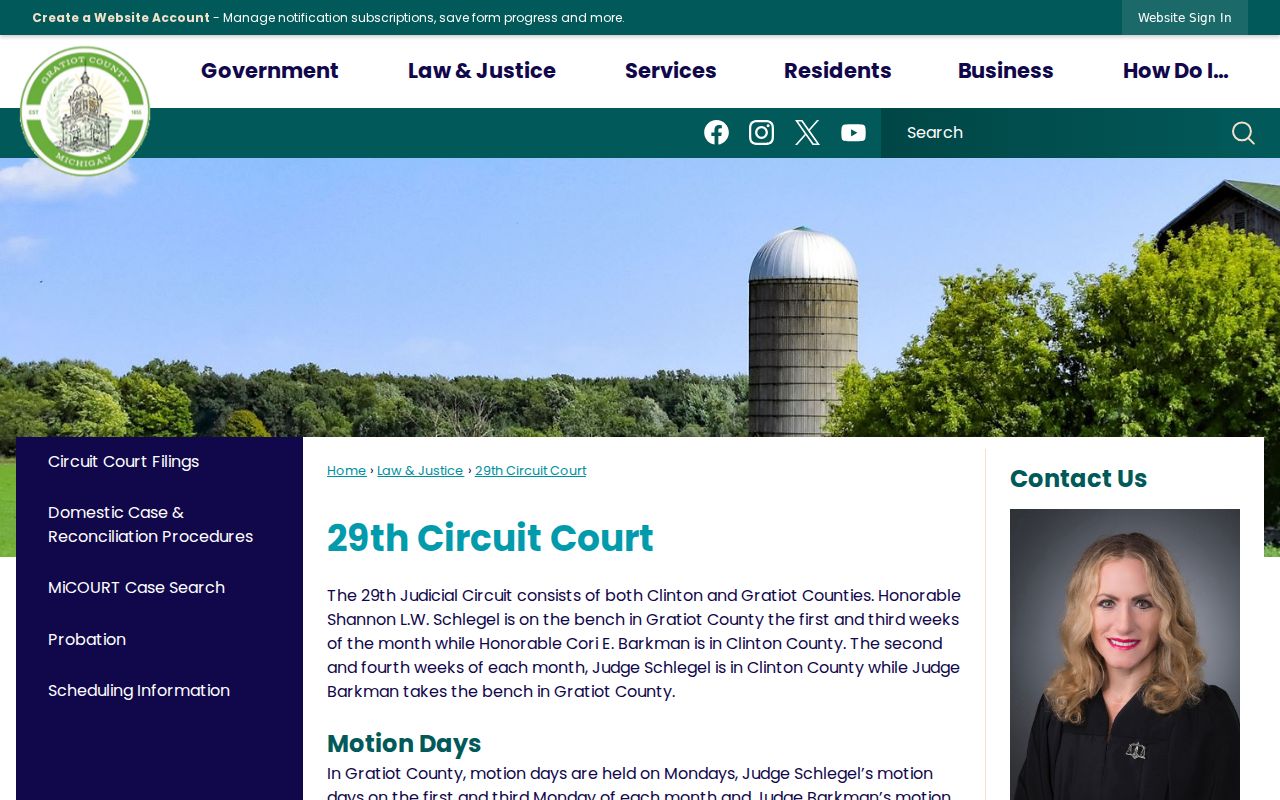
The 29th Circuit Court's official court page lays out the shared circuit structure and the local judicial rotation.
Because Gratiot County splits its criminal work between two courts, a thorough search often touches both channels. A Gratiot County criminal docket search may need the 65B records as well as the circuit file.
Courts That Hold Criminal Dockets
Two courts split the criminal dockets. District Court 65B handles misdemeanors countywide plus the first phase of every felony. The 29th Circuit side runs through the County Clerk. That office files and keeps those criminal records. Note that federal charges live outside the Michigan system entirely. A state MiCOURT search will never return them.
65B District Court
District criminal cases, arraignments, preliminary examinations, live calendar, and public record requests.
989-875-5240
29th Circuit and County Clerk
Felony dockets after bindover and circuit court record assistance.
Circuit: 989-875-5224
County Clerk: 989-875-5215
Gratiot Criminal Record Counter
Need a deeper look at the criminal docket? The 65B access-to-court-records page points you to a public terminal at the courthouse when the online docket comes back thin. It opens at 8:30 a.m. and closes at 4 p.m., first come, first served. You sign in and out. You generally get 30 minutes unless nobody else is waiting. Printing runs $1 per page. Staff suggest coming between 1:30 and 3:30 p.m. if you want a same-day request. A same-day result is never promised, though.
Need copies, a full file, one document, or a recording? File the 65B file and copy request form. You can submit it in person, by mail, phone, or fax. The court's published email route also works. Staff pull any nonpublic material and tally charges before releasing anything. Gratiot records from before 1996 may sit in index books that need a manual search. So a blank online result is not the end of the historical trail. Viewing on the terminal is not a license to export or bulk-copy the court database.
The County Clerk runs a separate circuit record search covering circuit cases only. It costs $12 per name for a ten-year span. Other time ranges can add a fee. Say which years you want. Say whether your request involves the district phase, the circuit phase, or both. The official court docket stays with whichever court or clerk maintains the file.
Sealed Dockets and Public Access
Access to Michigan judicial records runs through MCR 8.119 and the related Michigan Court Rules. A FOIA request is not the route. The public may inspect and copy court records under reasonable court procedures. Still, a case existing does not make every page in its file public. Sealed, confidential, redacted, and nonpublic material sits outside ordinary access. Juvenile matters and other sensitive categories carry extra limits. A public calendar never shows the events it omits.
Access rules to use:
MCR 8.119 makes public case records generally available while preserving rule-based limits and court procedures.
MCR 1.109 governs filing practices and protected personal-identifying information.
65B Administrative Order 2013-05 sets the local court-record access process and nonpublic-record controls.
Gratiot Specialty Criminal Dockets
Gratiot County joins regional problem-solving courts. Their public program descriptions are not open participant lists. A hearing becomes public only when the case beneath it and the event itself are public. So a calendar entry proves nothing about enrollment, treatment, diagnoses, testing, or personal details. The right question is whether the case and the docket event are public. A program name in a news story or schedule proves nothing.
The Mid-Michigan Regional Mental Health Court serves Gratiot, Clinton, Montcalm, and Ionia Counties. Its official description lays out four phases. It also covers treatment and support components, regular review hearings, and transfers of felony or misdemeanor cases.
The structure explains what a public event means. It settles nothing about an individual case or restricted details.
The Mid-Michigan Regional Sobriety Court takes qualifying felony and misdemeanor matters and transfers. Its reach runs across Gratiot, Montcalm, and Clinton Counties. Its four-phase design combines treatment, testing, support, and court review.
On any specific Gratiot criminal docket, the clerk's public-access determination wins. No assumption drawn from a specialty-court program page overrides it.