
Searching the St. Louis Court Docket
No separate St. Louis municipal docket appears in the city's official materials. There is no city calendar or payment portal either. For a district-level St. Louis matter, use the MiCOURT Case Search. Select the Gratiot court if the interface allows it. A last name or business name is enough to begin. A known case number is faster. Choose the Year, Number, and Type panel for that route. Before treating any St. Louis result as the right record, slow down and check the details. Look at the court, the case type, the party role, and the public status. Then check the filing date, the events, and the disposition.
Older, sealed, or nonpublic St. Louis cases may return nothing online. The public calendar can still show an open public event. When it does not, use the documented fallbacks. These are the court counter, the phone line, a terminal, and a record-copy request. Bring the exact party name and the case number if you have it. Also bring the St. Louis document or hearing you need.
- Open MiCOURT and choose the Gratiot court for a St. Louis court docket search when that selection is offered.
- Enter the required last name or business name, or use Year, Number, and Type for a known St. Louis case.
- Match the St. Louis result by court, case type, party role, public status, and filing date.
- Use the 65B public calendar to check a scheduled St. Louis hearing, then confirm a needed appearance with the court.
- Ask 65B for a record review or copy when the St. Louis case cannot be confirmed from the public index.
St. Louis Government and Court System
The City of St. Louis government runs as a Home Rule city. It has a city manager and council. Its listed phone number is 989-681-2137. Call there for civic questions or code information, not for a court docket. City Hall keeps no state-court counter. For court records tied to St. Louis, the route is the county's 65B District Court. Its jurisdiction expressly covers the city.
Know which door you are knocking on. City staff can explain an ordinance or a local board. But the court system is where filings, hearings, and orders live. A case that happened inside St. Louis still belongs to the court that took it, so ask that question before submitting any request. Sending a docket request to City Hall will only slow you down.
The official St. Louis government page lays out the city offices and services in detail.

St. Louis civic navigation appears there, but it is not a court or police docket source.
St. Louis Municipal Court Basics
Treat "St. Louis municipal court" as a routing label only. It is not the name of a real court. The official city materials name no separate municipal court. They list no city docket, city calendar, or city payment route. Do not relabel 65B as a municipal court. The state-court record for a qualifying St. Louis matter sits with the system that has jurisdiction. That system is the district, circuit, probate, or family court.
65B handles countywide traffic civil infractions and parking citations. It also covers traffic misdemeanors, misdemeanors, small claims, and general civil matters within its limits. A felony can begin at 65B. It may move to the 29th Circuit Court after a preliminary examination and bindover. St. Louis changes none of that flow. The case type and the court decide the docket destination, not the city address.
Note: A St. Louis civic record may be informative. Only the accepting court can supply a case number or disposition.
St. Louis Live Calendar Fields
The 65B Court Calendar is the public scheduling route for a St. Louis hearing. It links to the MiCOURT public display and refreshes about every 30 minutes. Pick a date and the public events appear. The fields that matter are Party Name, Time, Room, and Case Number. You can navigate by court and date. Then compare the entry against a MiCOURT record for the same St. Louis case.
Room "Hearing" has a local meaning. It marks an informal hearing before a magistrate. The calendar entry is still not the full docket. A public setting will not list every filing. It omits past events, continuances, sealed items, and the final disposition. When the calendar falls short, the court clerk can confirm the current St. Louis setting.
Court Dates and Settings in St. Louis
Find the public St. Louis event on the calendar. Pull the case number and check the public case index. If attendance matters, call 65B at 989-875-5240. Calendar settings can change. A blank display does not prove a cancellation, a dismissal, or the absence of a case. Nonpublic cases are omitted. A date filter can hide events too, even while the court is active.
| Party Name | Shows the public St. Louis party listed for the chosen date; case number and role should confirm identity. |
|---|---|
| Time | Shows the scheduled St. Louis event time, subject to later court changes. |
| Room | Shows the listed public location, including the local “Hearing” designation where applicable. |
| Case Number | Links the St. Louis calendar event to the case search and a specific record request. |
| Public Status | Limits what the display can show; a public calendar is not a complete case-file inventory. |
Circuit matters work differently. The 29th Circuit Court uses assignment clerks to schedule motions, so a 65B calendar date tells you nothing about a circuit setting.
St. Louis City Code and Disposition
A city code or charter page can tell you which local rule applies. It also shows which agency handles a St. Louis issue. That is all it does. It shows no court case was filed. It can never stand in for a disposition. The disposition is the court's recorded result. It may be a judgment, a dismissal, a plea, a verdict, or a settlement entry. For any St. Louis docket question, the court that took the case owns the answer.
Use the code only to understand the conduct behind a case. Then get the case number. Ask 65B, the County Clerk, or the right court for the docket or the document itself. That order keeps a code citation from being read as a court outcome. It also keeps nonpublic material out of a general search.
Traffic Tickets in St. Louis
A qualifying St. Louis traffic case lives in the countywide 65B system. The documented routes are the Traffic Division, MiCOURT, and the public calendar. One ticket might be a civil infraction or a parking citation. It could also be a misdemeanor, an informal magistrate hearing, or a formal hearing. The city name printed on it does not create a St. Louis municipal docket. It does not create a city payment page either.
The official traffic instructions give firm deadlines. Payment is due within 14 days. A mailed payment needs a postmark by day 14. If the ticket does not require a personal appearance, request a not-guilty or not-responsible hearing within 14 days. Do it by calling 989-875-5240. When the ticket or a current court notice says something different, that notice controls.
For more countywide detail, see Gratiot County traffic tickets. The city route is still 65B, not an assumed St. Louis portal.
St. Louis Court Payment Codes
The two county GovPay codes do different jobs. Traffic payment information uses payment location code 6732. County Clerk payments use PLC 5159. Never swap them. A St. Louis ticket goes through the 65B Traffic Division route and its code, while a Circuit Court or County Clerk payment follows the clerk's route and code.
| St. Louis payment need | County route | Code |
|---|---|---|
| Traffic fine or cost | 65B Traffic Division / GovPay route | PLC 6732 |
| County Clerk payment | County Clerk / GovPay or phone route | PLC 5159 |
Processing charges can apply. A code alone will not tell you whether a St. Louis matter qualifies for online payment. Check the court notice or call the court instead of paying under the wrong agency.
Where St. Louis Cases Go
St. Louis district civil matters, small claims, traffic cases, parking matters, misdemeanors, and the early district phase of felony cases all go to 65B. A felony may bind over to the 29th Circuit Court. Circuit civil cases generally over $25,000 take the circuit and County Clerk route. Family matters do too. Probate belongs in Probate Court. This map lets a St. Louis searcher pick the right docket without inventing a city court.
Docket flow: St. Louis-origin event → 65B District Court for district jurisdiction → 29th Circuit Court after felony bindover or for circuit jurisdiction
MiCOURT is the statewide public index layer for many St. Louis state cases. For copies, the court holding the original file is the source. Federal cases run on a separate federal system, so a St. Louis state-court search is not a search of federal cases.
St. Louis Record Copy Requests
A St. Louis copy request needs full details. Name the court, the case number, a party, and the document type. Then say what you want: review, a plain copy, a certified copy, a CD, or an emailed document. The 65B file and copy request form separates those request types. Staff can flag the public portions, tally the charge, and explain how delivery works.
65B offers several documented channels. You can use in-person, mail, phone, fax, or the court's published contact route. The public terminal is one more way to view records. Access is first-come. It is generally capped at 30 minutes a day. Prints cost $1 per page. St. Louis records from before 1996 may need the manual index books. Those sit at the counter.
Ask for a court record, not a civic code page. Name the exact document whenever you can.
St. Louis Court Record Access Rules
Michigan court rules govern St. Louis court records, not ordinary FOIA. Under MCR 8.119, public case records are generally open. Sealed, nonpublic, confidential, redacted, and other restricted material stays off limits. An open case index has limits. It does not turn the whole St. Louis file into a free document viewer.
Michigan FOIA defines its public bodies. MCL 15.232 leaves courts out. County administration may hold FOIA records. A St. Louis judicial file follows court-record procedures instead. The court also bars some categories. Juvenile, adoption, PPO, mental-health, will, and other protected categories are among them. Confirm the court, case number, and record type before any St. Louis request.
Key Rules:
MCL 15.232 explains why Michigan court case records do not follow the ordinary FOIA path.
MCR 8.119 governs inspection, copying, and public-access limits for the St. Louis court record route.
65B Administrative Order 2013-05 adds local court-record access procedures.
Michigan's judiciary exclusion language is the official source represented by this record-access image.
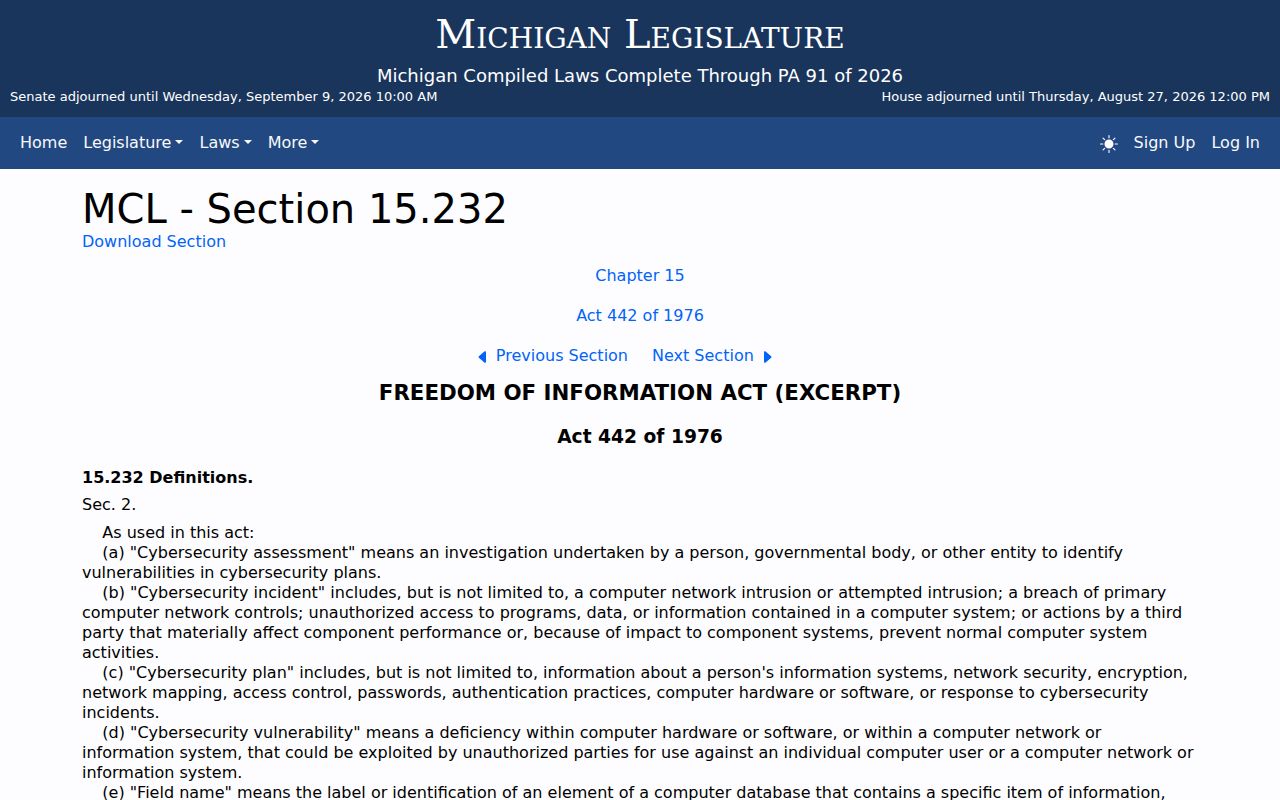
The record-access source shows why a St. Louis court file must go through the court process. An ordinary FOIA channel will not reach it.
St. Louis City Docket Context
Population tells you where St. Louis sits in Gratiot County. The 2020 Census counted 7,010 residents there. Alma came in first at 9,488, and Ithaca third at 2,853. St. Louis ranks second among the county's three incorporated cities. That is a shorter list than some expect. The ranking is helpful civic background, nothing more. It does not create a St. Louis city docket. It does not alter the countywide 65B court jurisdiction either.
Treat the three city pages as routing help. St. Louis facts point you toward the right public state-court channel for a case lookup. The final word still rests elsewhere. It belongs to the court that holds the case, its official notice, and its public-access rules.